

Vassiliadis Elementary Highlights Summerlin’s Team Approach to Learning |
Teacher collaboration, data-informed instruction and parent support help the school stand out in Southern Nevada |
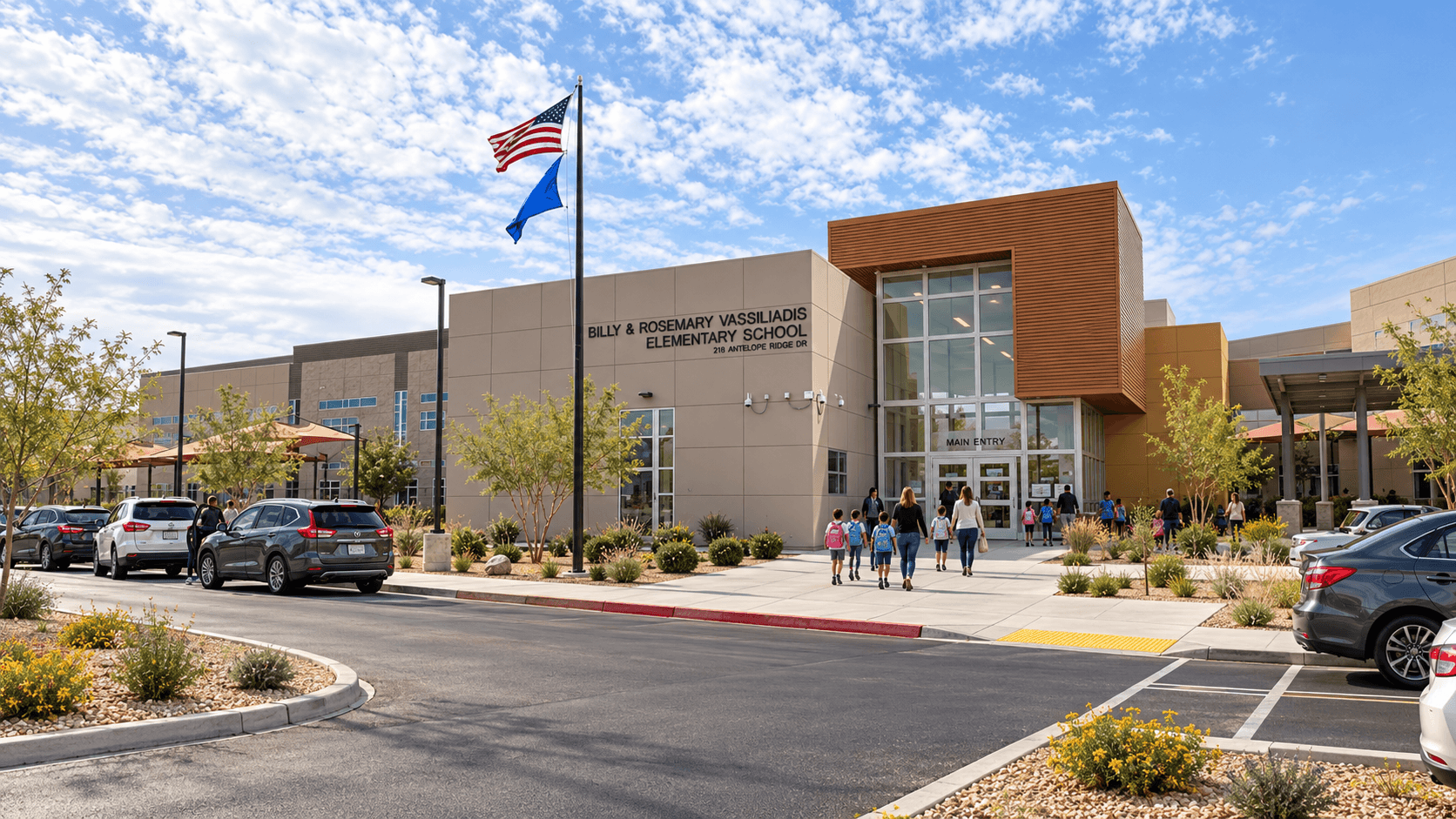
Vassiliadis Elementary is reaching about 80% proficiency in math and English language arts—roughly twice the Clark County School District average cited in the Nevada Report Card.
That number will catch any Summerlin parent’s eye. But the more useful story is what happens behind the score: teachers study student data, families support classroom goals, and school leaders keep the focus on individual progress.
For families comparing schools, Vassiliadis offers a practical question to consider: What systems help students get the right support at the right time? The answer begins with a team culture that treats learning as a shared responsibility.
How Vassiliadis builds its academic approach
Principal Jennifer Aznarez, who became the school’s principal this year, mentioned that teachers and parents are central to the campus culture. She also described students as challenged and engaged at high levels.
The school’s roughly 80% proficiency rates come from Nevada Report Card information cited in the report. Those results help explain why the Summerlin campus is often recognized among Nevada’s stronger public elementary schools, but they do not tell the whole story.
Test results are a snapshot. Families also care about classroom relationships, communication, support for different learning needs, and whether students feel motivated to keep working when a lesson becomes difficult.
Teachers use data as a working tool
Fifth-grade teacher Rachel Levandusky has been at Vassiliadis since the school opened 10 years ago. She pointed to the campus culture and supportive leadership as important reasons she has stayed.
Levandusky also said teachers use data to guide instruction. Grade-level common assessments help staff identify which skills students have mastered, where more practice is needed, and how lessons should change.
The goal is not to place every student on the same track.
It is to give teachers enough information to extend learning for students who are ready for more challenge and provide additional explanations for students who need them.
That process can make parent-teacher conversations more useful. Instead of discussing grades in broad terms, families can ask which skills are being measured, what the results show, and what practice would help at home.
Parents are part of the school’s support system
School staff also credit parents with giving time, resources and donations to support classroom goals. Aznarez said fundraising supports classrooms and staffing, connecting family participation to the school’s day-to-day work.
Parent involvement does not have one required format. It may include volunteering, attending meetings, responding to teacher requests, helping with homework routines, or contributing supplies and financial support.
For students, that consistency matters. When school and home communicate about expectations, children receive a clearer message about effort, attendance, practice, and asking for help.
Families should still ask what participation looks like at a specific campus. Not every household has the same work schedule, transportation options, or resources, and a strong school partnership should make room for those differences.
What the school’s approach emphasizes
Vassiliadis serves about 1,100 students. A campus of that size needs routines that allow teachers to share information and keep support from depending on one person’s memory or availability.
The school’s performance also comes as CCSD works to improve results across the valley. The district reported that 32 schools earned five-star ratings during the last school year, 51 improved their scores by at least 10 points, and four schools achieved both milestones.
Those district figures provide context, but they do not make every school identical. Vassiliadis’s results reflect its own staff, students, families, and resources in Summerlin.
For West Valley families, the takeaway is practical. Strong academic performance is built over time through teaching quality, feedback, student engagement, and a support network that includes caregivers.
Parents evaluating any school can carry forward a few straightforward questions:
The answers will vary by campus. Vassiliadis Elementary’s example shows how teachers and parents can share the work of helping students move forward—one lesson, conversation, and adjustment at a time. |
 |

Oct 23, 2026
Municipal Gym Moves Closer to Opening in Downtown Summerlin
Municipal Gym, Mark Wahlberg’s fitness concept with EōS Fitness, is expected to open in Downtown Summerlin in early 2027.

Oct 23, 2026
Summerlin’s Slow Your Roll Campaign Puts School-Zone Safety in Focus
Summerlin’s Slow Your Roll campaign brought mascots, law enforcement and school-safety leaders together to reinforce safer driving around schools.

Oct 22, 2026
William Lummis Elementary Opens Remodeled Library
William Lummis Elementary in Summerlin unveiled a remodeled library as part of a College Football Playoff Foundation-supported CCSD literacy effort.

Oct 22, 2026
October Events at The Resort at Summerlin
The Resort at Summerlin's October release lists late-month Round Bar music and Halloween Bingo Room programming on October 31.
12 Comments
Join the conversation
The 80% proficiency rate is impressive, but I wonder how much the fundraising helps. Not every CCSD school has families who can give extra.
Love that teachers use the common assessments to see who needs more practice. It sounds more helpful than waiting for a report card.
My daughter did better once her teacher told us exactly which math skills to practice at home. Those specific conversations really do help.
With 1,100 kids at Vassiliadis, how often do teachers get time to review those assessments together? That seems like a big part of making it work.
The 80% proficiency rate is impressive, but I wonder how much the fundraising helps pay for extra staff. Not every CCSD school can raise the same amount.
Dave ThompsonI wondered that too. It would help to know how many staff positions the fundraising covers before comparing schools.
Glad to see Vassiliadis doing well, though I wouldn’t judge a school on proficiency alone. How kids feel about going to class matters too.
Eddie FloresExactly. I'd want to know whether kids feel comfortable asking for help, especially at a school with 1,100 students.
Absolutely, test scores are only a snapshot. Classroom relationships, student engagement, and how children feel when learning gets tough matter too.
Love that the teachers use common assessments to see who needs more help. Catching a problem during the year is so much better than waiting for final grades.
I'm glad parent involvement includes things besides volunteering. Plenty of families can't make daytime events but still keep up with homework and teacher messages.
Absolutely. Staying in touch with teachers and supporting homework routines are meaningful ways to participate, even when daytime volunteering isn’t possible.